Skip to content



A med spa website should show a pop-up only after a visitor has engaged with the page: after a 10 to 15 second delay, once they have scrolled 50 to 60% of the way down, or when they open a second page. Growth99 data shows that immediate pop-ups can increase bounce rates by up to 35%, particularly for new visitors who arrive from organic search.
The short answer: Never show a pop-up the instant the page loads. Growth99’s analysis of thousands of med spa websites points to three triggers that work: a time delay (6 to 15 seconds, with stronger results at 10 to 50 seconds), a scroll trigger (50 to 70% of the page), or a second-page view. On mobile, be more patient: 15 to 20 seconds or 60 to 70% scroll. Pair the right timing with one clear offer and a short form.
Key Takeaways
- Immediate pop-ups can increase bounce rates by up to 35%, especially for new organic visitors.
- Time delays, scroll depth, and second-page views are the three triggers that perform best.
- Mobile visitors need longer delays and deeper scroll triggers than desktop visitors.
- A complimentary consultation or useful guide makes a stronger offer than a recurring discount.
- Test your timing and watch bounce rate, conversion rate, and form abandonment together.
In This Article
- Understanding Why Immediate Pop-Ups Backfire
- Choosing the Right Trigger: Time, Scroll, or Second Page
- Understanding Why Delayed Pop-Ups Convert Better
- What Growth99 Testing Shows
- Deciding What Your Pop-Up Should Offer
- Adjusting Pop-Ups for Mobile Visitors
- Testing and Measuring Your Pop-Up
- Responding the Moment a Lead Comes In
- Pop-Up Best Practices Checklist
- Frequently Asked Questions
- Key Insights
Understanding Why Immediate Pop-Ups Backfire
Think about the visitor’s side of the screen. A woman in her early 40s searches “laser hair removal near me” on her phone during a lunch break. She taps your site, and before she can read your headline or see a single treatment photo, a box covers the page asking for her email.
She hasn’t learned what makes your practice different. She doesn’t know yet whether you offer the treatment she searched for, or why she should trust you. You’ve asked for a commitment before she’s had a chance to look around, and one tap on the back button sends her to the next practice in the results.
For med spas, this timing problem is sharper than for most businesses. People researching aesthetic treatments are usually early in their decision. They want to compare options, study before-and-after photos, and get a feel for your professionalism. An immediate pop-up interrupts that research at exactly the wrong moment.
There’s a search visibility cost, too. Google has said that intrusive pop-ups blocking content on mobile, right after a visitor arrives from search, can affect how a page ranks.
Choosing the Right Trigger: Time, Scroll, or Second Page
Growth99’s research with med spa clients consistently points to three timing strategies. Each one waits for a signal that the visitor is genuinely interested.
- Time-based delays. Pop-ups perform well when they appear after 6 to 15 seconds, which gives visitors time to orient themselves and start reading. Waiting 10 to 50 seconds performs even better, because a visitor still on the page at that point is clearly interested in what you offer.
- Scroll-based triggers. Show the pop-up once a visitor has scrolled 50 to 70% down the page. Someone halfway through your “What to Expect at Your First Visit” page is far more likely to convert than someone who just arrived.
- Second-page triggers. Show the pop-up only after a visitor opens a second page. That behavior shows she’s seriously exploring your practice, not just passing through.
If you’re choosing a single starting point, begin with a 10 to 15 second delay or a 50 to 60% scroll trigger, then adjust based on your own results.
Understanding Why Delayed Pop-Ups Convert Better
Booking an aesthetic treatment is a considered purchase. Unlike buying a t-shirt online, it takes trust, research, and confidence in the provider.
A delay gives your website the time to earn that trust, and it accomplishes three things:
- It lets visitors get to know your practice. They see your credentials, meet your providers, browse your treatments, and sense the atmosphere of your spa.
- It shows respect for their time. That small courtesy previews the kind of care they can expect in person.
- It makes your offer more relevant. After reading about your signature facial or laser technology, a complimentary consultation feels like a natural next step instead of an interruption.
What Growth99 Testing Shows
Across med spa websites that switched from immediate pop-ups to delayed triggers, Growth99 testing found:
- Reduced bounce rates, particularly among organic traffic
- Higher conversion rates on pop-up forms
- More time spent on site
- Stronger overall engagement
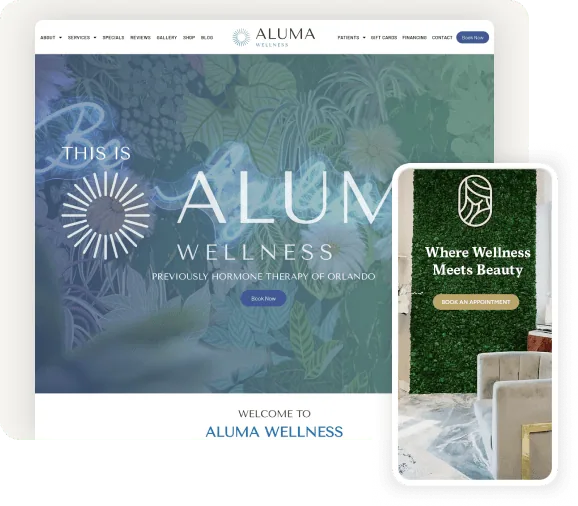
One Growth99 client saw especially strong results with a simple, focused pop-up and a short form that appeared only after visitors had time to engage with the site. That combination of patient timing and a clear offer has become a model for other practices we work with.
A website built to turn visitors into booked consultations treats pop-up timing as one part of the conversion path, alongside page structure, calls to action, and load speed.
Deciding What Your Pop-Up Should Offer
Timing is half the equation. The offer is the other half. The strongest med spa pop-ups focus on one clear next step:
- A complimentary consultation or skin analysis. A low-risk way for a new patient to meet your team.
- A useful download. For example, a guide to choosing the right injectable or preparing for a first laser session.
- A single welcome offer for first-time patients. If you use one, keep it a one-time welcome rather than a recurring promotion, so you don’t train patients to wait for the next discount. Our guide to loyalty-building email campaigns explains why that distinction matters.
Keep the form short. Name, email, and phone number are usually enough. The pop-up’s job is to start the conversation; you can collect everything else during consultation scheduling.
Adjusting Pop-Ups for Mobile Visitors
More than half of med spa website traffic typically comes from mobile devices, where a pop-up takes up more of the screen and is harder to close. For mobile visitors, Growth99 recommends:
- Longer delays of at least 15 to 20 seconds.
- Deeper scroll triggers at 60 to 70% instead of 50%.
- An easy-to-tap close button that’s large and clearly visible.
- Exit-intent triggers as an alternative to timed pop-ups.
Accessibility belongs on this list too. A pop-up should be closable by keyboard, readable by screen readers, and shouldn’t trap focus. Those details protect patients and reduce risk, which is why website accessibility and compliance deserves a place in your site review.
Testing and Measuring Your Pop-Up
Every med spa website is different, so your ideal timing may vary slightly from these findings. Test different triggers and offers, and track four numbers together:
- Conversion rate: how many visitors submit the form.
- Bounce rate: how many visitors leave immediately, especially from organic search.
- Time on site: whether the pop-up helps or hurts engagement.
- Form abandonment: how many visitors start the form but don’t finish.
Growth99’s platform offers built-in analytics that make this tracking straightforward, so you can see which timing works for your audience without building reports by hand.
Responding the Moment a Lead Comes In
A captured lead only matters if someone follows up while she’s still interested. The patient who fills out your pop-up at 9pm is comparing practices that same night. An AI front desk that responds to new inquiries makes sure that lead hears back from you before she calls anyone else.
Pop-Up Best Practices Checklist
- Never show a pop-up immediately on page load.
- Use time delays of 10 to 50 seconds or scroll triggers at 50 to 70%.
- Consider second-page triggers for deeply engaged visitors.
- Keep forms short and focused on one clear offer.
- Adjust mobile timing to be more conservative than desktop.
- Test timing and offers to find what works for your audience.
- Monitor bounce rates closely, especially for organic traffic.
Frequently Asked Questions
How long should a med spa wait before showing a pop-up?
Growth99 data shows pop-ups perform best after a delay of at least 6 to 15 seconds, with even stronger results at 10 to 50 seconds. A good starting point is a 10 to 15 second delay on desktop and 15 to 20 seconds on mobile.
Do pop-ups hurt a med spa website’s SEO?
They can on mobile. Google has stated that intrusive interstitials that block content right after a visitor arrives from search can affect how pages rank. Delayed, easy-to-dismiss pop-ups avoid that problem.
What should a med spa pop-up offer?
A complimentary consultation or skin analysis, or a useful download such as a treatment guide, works well. Keep the form to name, email, and phone number, and focus on one clear offer.
Key Insights
- Pop-up timing is a trust decision: ask for contact details only after visitors have had a chance to know you.
- Growth99 data ties immediate pop-ups to bounce rate increases of up to 35%.
- Scroll depth and second-page views are strong signals of genuine interest.
- Mobile visitors need more patience, larger close buttons, and accessible design.
- A pop-up starts the patient relationship; fast follow-up keeps it going.
Growth99 has helped hundreds of med spas improve their website conversions, and pop-up timing is one of the simplest changes with an outsized effect. Give visitors room to explore, make one clear offer when they’re ready, and your consultation calendar will reflect the difference.